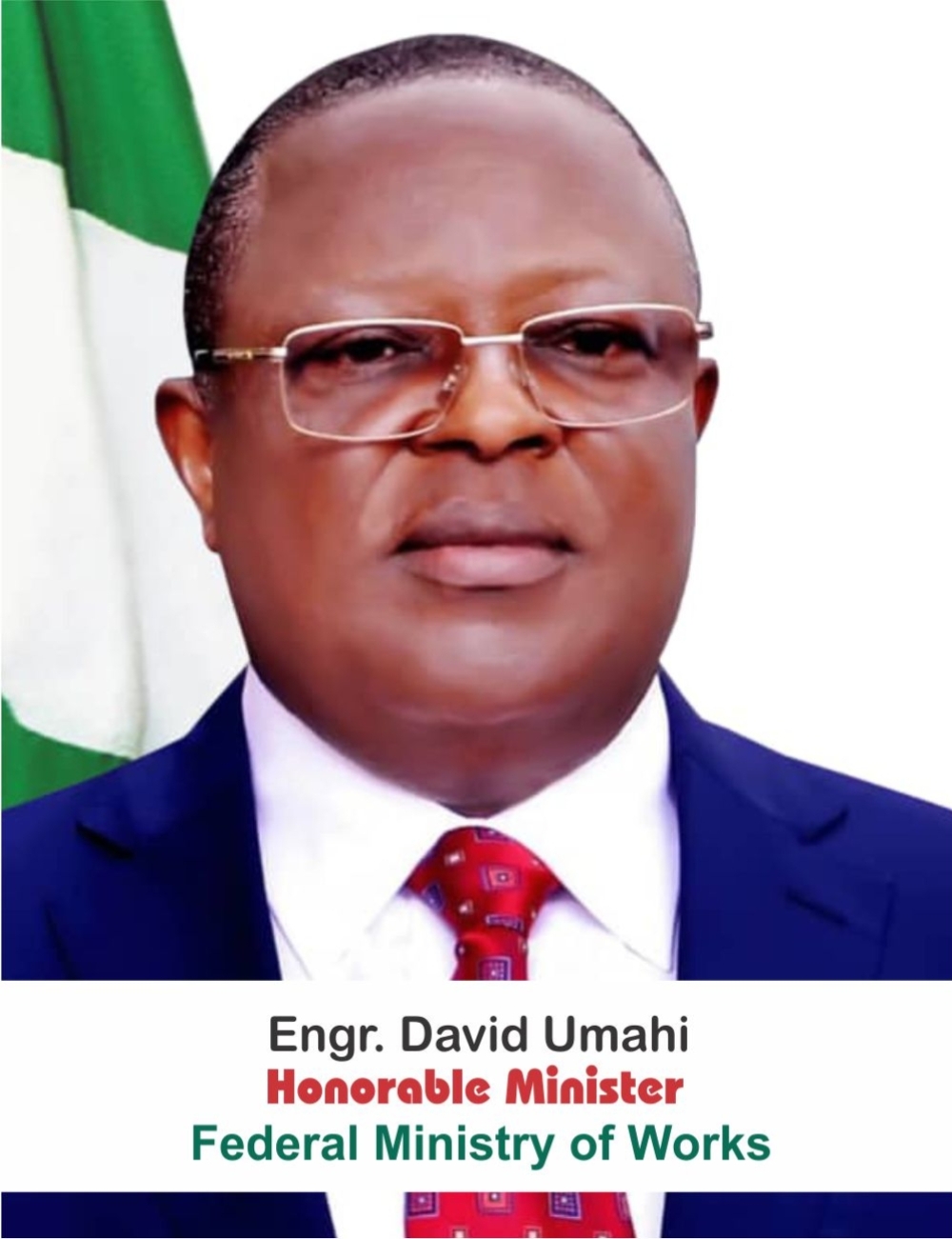
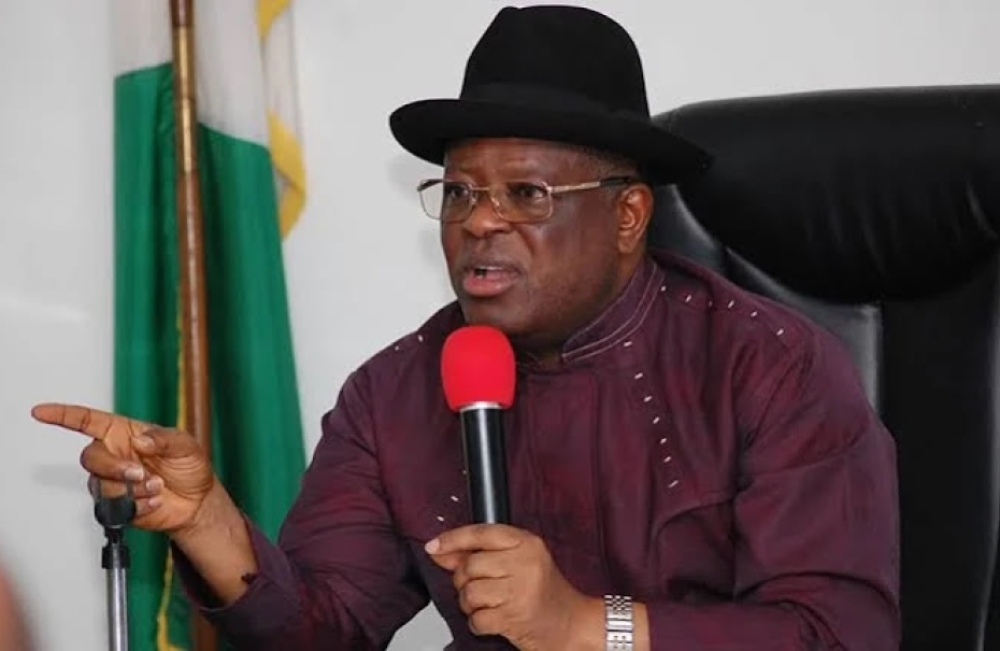
UMAHI ORDERS IMMEDIATE EMERGENCY INTERVENTION ON BENIN-ASABA ROAD, AND SOME OTHER CRITICAL FEDERAL ROADS
The Honourable Minister of Works, Senator Engr. David Nweze Umahi, CON, has directed the immediate deployment of major contractors to all three sections of the Benin-Asaba Federal Road to restore the failed sections and bring an end to the suffering of motorists and other road users.
This is because, the situation on the concessioned Benin-Asaba Road has reached a point where the overall public interest must take precedence over the existing concession agreement.
Recall that the Honourable Minister of Works was on the Benin-Asaba Road about seven days ago, where he assembled a number of contractors and directed them to prepare for immediate palliative intervention on the affected sections of the road at no cost to the concessionaire. In line with the Concession agreement which requires that before the Federal Government could intervene, the permission of the concessionaire must be required, and that permission was not granted to federal government.
The Minister subsequently proposed three options to the concessionaire, any one of which would have enabled the Federal Government to move in and address the worsening condition of the road. Unfortunately, none of the options was accepted by the concessionaire. Immediately after the Minister left Asaba, the already limited equipment deployed to the road by the concessionaire was further reduced to just one, worsening the situation and increasing the suffering of motorists and other road users.
While the Minister takes responsibility for the concerns and suffering of Nigerians using the road, it is important to state that the concessionaire has also not taken the suffering of Edo people and travelling public sufficiently into consideration by declining all the options put forward by the Federal Government. The concessionaire continues to rely on the terms of the concession agreement entered into by the previous administration, an agreement which weighs heavily against the Federal Government’s ability to intervene quickly in the interest of the public in a situation like this.
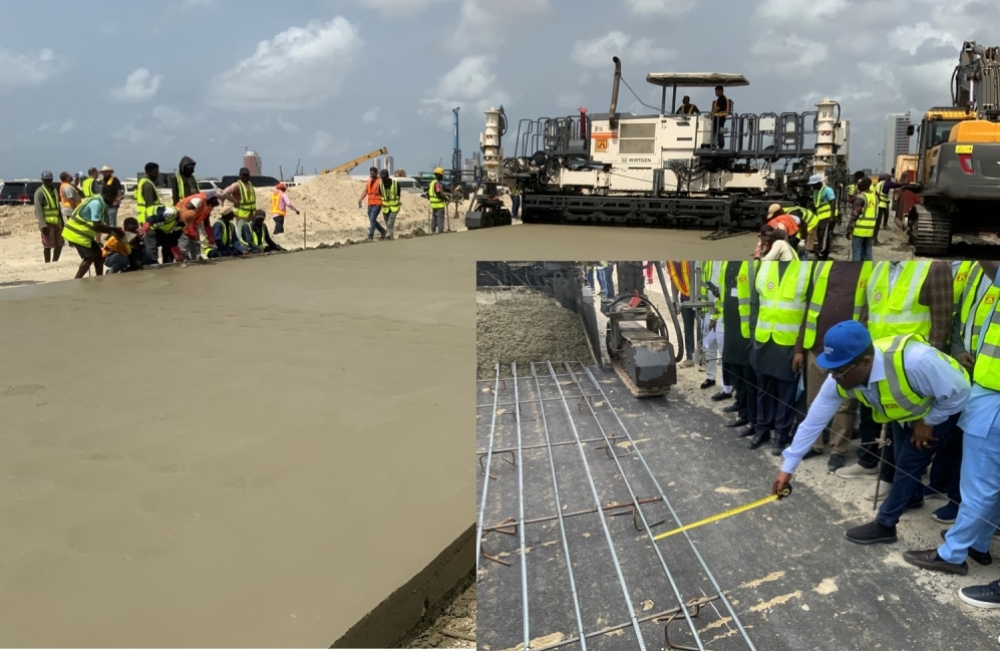
In view of this situation, the Honourable Minister of Works has directed the immediate deployment of major contractors within the corridor to all three sections of the Benin-Asaba Road to restore the failed sections and bring relief to the people, with the cost of the emergency intervention being borne by the Federal Government. The Honourable Minister has also directed immediate redesign of the entire route to be rebuilt with reinforced concrete pavement. The public should therefore take note that immediate action is underway to restore every failed section of the Benin-Asaba Road and subsequently rehabilitate the entire sections of the road using reinforced concrete pavement.
2. On the Benin-Sapele Road:
The Governors of Edo and Delta States, the Niger Delta Development Commission (NDDC), and the Federal Government are currently engaged in interventions on different sections of the road to restore the entire route. While some sections are receiving palliative attention, permanent works are also ongoing on other sections.
3. On Ifaki(Ekiti) - Kabba (Kogi) Road:
The Federal Government is engaging both the contractor; Gamji Nigeria Company Limited, and Dangote PLC on immediate emergency and permanent intervention on the most failed sections of the road, while efforts are being made to financially mobilise the company for more extensive permanent work to commence on the axis.
4. On the Sokoto-Zamfara-Katsina Road: This is an inherited project involving the dualisation of approximately 350 kilometres, which translates to about 700 kilometers. The project has since been redesigned and is currently ongoing and most sections are being reconstructed using reinforced concrete pavement. From the Sokoto axis towards Zamfara, over 50 kilometres of one carriageway have been fully completed with reinforced concrete pavement. From Zamfara to Katsina, some sections have been completed and palliative works have been ordered over the sections that have not been reconstructed. However, the pace of work slowed down due to the redesign and rephasing of the project. The contractors currently engaged on the road include CBC, SETRACO, Triacta and Mothercat. They are being remobilised to return to site and complete the outstanding works.
5. On the Abuja-Kaduna-Zaria-Kano Road: The Federal Government took over the Road project and has currently completed the 118-kilometer mostly on reinforced concrete pavement on lot 1. The Lot 2, which covers 164 kilometres, is over 60 percent completed on reinforced concrete pavement. The Federal Government has also introduced solar-powered light on the entire route of Abuja-Kaduna-Zaria - Kano to improve visibility during night travel and enhance the overall security situation on the route. The entire project is scheduled for completion by December 2026.
6. On Bauchi-Jigawa Road: Triacta Nigeria Limited has been mobilised to carry out the necessary interventions on some failed sections and work is currently ongoing in those failed sections.
7. On the Sagamu-Ore Road: 48 Kilometers of the 96-kilometre road have already been completed using reinforced concrete pavement. There is also a 24-kilometre section around Ore which was abandoned by the previous contractor. The Federal Government has directed its immediate restoration to ensure seamless travel. Solar lights are being installed in the entire 96kilometer of the road.
8. On Flooded Sections on Sagamu-Ore-Benin Road: The flooded sections on the same corridor between Sagamu-Ore-Benin Road, as well as other flooded sections in Ondo State, are being designed for emergency procurement and intervention.
9. On the East-West Road:
Some failed and critical sections, including defective sections of bridges along the East-West Road, are being marked out for emergency procurement and intervention.
10. On the Abuja-Lokoja Road:
Several contracts are ongoing along the route, while the three critical sections currently without contracts are being procured for emergency intervention.
11. On the Lokoja-Benin-Warri Road: The President has directed a complete redesign and procurement of the 400-kilometre dualised route covering the uncompleted sections, using reinforced concrete pavement, while palliative works will continue with the contractors currently on the road.
12. On Carter Bridge:
While the Federal Government continues to undertake weekly maintenance of the underwater elements of the bridge. The site has also been handed over to the contractor, CCECC, for the construction of a permanent new bridge, and work has commenced.
13. On the Third Mainland Bridge:
With regard to the defective underwater structural elements, the Federal Government is at the final stage of determining the appropriate intervention for the repair of the affected elements.
14. On the flooded section of the Lagos-Ibadan Road: Work has commenced on the affected section. There are also several flooded sections on federal roads across the six geopolitical zones, largely occasioned by excessive flooding and the effects of climate change. The Federal Government is identifying and marking these sections for immediate attention.
15. On the First and Second Niger Bridges:
Intervention work is ongoing on the approach roads to the Second Niger Bridge damaged by flood and the work is progressing very well. The First Niger Bridge has been closed to traffic to enable immediate repair works. Contractor has mobilized to site and comprehensive rehabilitation of the bridge has started. From Summit Junction to the First Niger Bridge, massive rehabilitation work is also ongoing using reinforced concrete pavement.
16. The Honourable Minister wishes to commend the President of the Federal Republic of Nigeria, His Excellency Bola Ahmed Tinubu, GCFR, for the massive work being undertaken on the nation’s roads since the administration assumed office in 2023.
17. It is important to state that when the present administration came into office, there was hardly any part of the country where one could travel for an hour without encountering significant challenges on the road network. The condition of the country’s roads and bridges was a major national infrastructure challenge.
18. Rather than shy away from the problem, the administration of President Bola Ahmed Tinubu made the nation’s road network a priority. Virtually every part of the country became a priority, and the Federal Government, through the Federal Ministry of Works, Regional Commissions, Parastatals and other MDA’s has continued to respond extensively to these challenges.
19. The Federal Government is currently working on over 80 percent of the inherited federal roads, an unprecedented level of intervention in the country’s road infrastructure.
20. We ask the public to understand the enormous challenges inherited on our roads and bridges and to take note not only of the problems being solved, but also of the permanent solutions being introduced.
21. A major part of this new approach is the use of reinforced concrete pavement, designed to significantly extend the lifespan of major roads. These roads are expected to last between 50 and 100 years. This means that roads being constructed under President Bola Ahmed Tinubu’s administration are being designed with future generations in mind, rather than simply providing temporary solutions to today’s problems. And this is a complete departure from the past, when roads often deteriorated only a few years after completion, resulting in a continuous cycle of reconstruction and expenditure.
22. We appreciate the concerns of Nigerians over the condition of some roads presently and the difficulties faced by motorists and commuters who cannot move easily from one point to another. Those concerns are legitimate, and the Federal Government is listening. But Nigerians should also recognise the enormous scale of the problems inherited and the amount of work currently being undertaken across the country.
23. It is simply impossible to resolve every road challenge accumulated over many years of neglect by the past administrations within three years. What is important is that the government is working, the government is responding, and the government is putting permanent solutions in place.
25. We appreciate members of the public who send situation reports on failed roads and other infrastructure challenges. These reports help the Ministry identify areas requiring urgent attention. However, we also appeal to members of the public to report when such problems have been addressed, just as they report when they occur.
24. We are aware of situations where photographs and reports of road challenges continue to circulate on social media even after the Federal Government has intervened and resolved the particular problem.
25. However, the Ministry will continue to respond as rapidly as possible to genuine reports and concerns from Nigerians.
26. It is also important to note that we have compiled a comprehensive record of all inherited, ongoing and intervention projects across the country which is available to the public. This is to ensure that Nigerians have access to information on the infrastructure projects being undertaken nationwide and can fully participate in and appreciate the infrastructure revolution of President Bola Ahmed Tinubu’s administration.

UMAHI ORDERS IMMEDIATE EMERGENCY INTERVENTION ON BENIN-ASABA ROAD, AND SOME OTHER CRITICAL FEDERAL ROADS The Honourable Minister of Works, Senator Engr. David Nweze Umahi, CON, has directed the immediate deployment of major contractors to all three sections of the Benin-Asaba Federal Road to restore the failed sections and bring an end to the suffering of motorists and other road users. This is because, the situation on the concessioned Benin-Asaba Road has reached a point where the overall public interest must take precedence over the existing concession agreement. Recall that the Honourable Minister of Works was on the Benin-Asaba Road about seven days ago, where he assembled a number of contractors and directed them to prepare for immediate palliative intervention on the affected sections of the road at no cost to the concessionaire. In line with the Concession agreement which requires that before the Federal Government could intervene, the permission of the concessionaire must be required, and that permission was not granted to federal government. The Minister subsequently proposed three options to the concessionaire, any one of which would have enabled the Federal Government to move in and address the worsening condition of the road. Unfortunately, none of the options was accepted by the concessionaire. Immediately after the Minister left Asaba, the already limited equipment deployed to the road by the concessionaire was further reduced to just one, worsening the situation and increasing the suffering of motorists and other road users. While the Minister takes responsibility for the concerns and suffering of Nigerians using the road, it is important to state that the concessionaire has also not taken the suffering of Edo people and travelling public sufficiently into consideration by declining all the options put forward by the Federal Government. The concessionaire continues to rely on the terms of the concession agreement entered into by the previous administration, an agreement which weighs heavily against the Federal Government’s ability to intervene quickly in the interest of the public in a situation like this. In view of this situation, the Honourable Minister of Works has directed the immediate deployment of major contractors within the corridor to all three sections of the Benin-Asaba Road to restore the failed sections and bring relief to the people, with the cost of the emergency intervention being borne by the Federal Government. The Honourable Minister has also directed immediate redesign of the entire route to be rebuilt with reinforced concrete pavement. The public should therefore take note that immediate action is underway to restore every failed section of the Benin-Asaba Road and subsequently rehabilitate the entire sections of the road using reinforced concrete pavement. 2. On the Benin-Sapele Road: 3. On Ifaki(Ekiti) - Kabba (Kogi) Road: 4. On the Sokoto-Zamfara-Katsina Road: This is an inherited project involving the dualisation of approximately 350 kilometres, which translates to about 700 kilometers. The project has since been redesigned and is currently ongoing and most sections are being reconstructed using reinforced concrete pavement. From the Sokoto axis towards Zamfara, over 50 kilometres of one carriageway have been fully completed with reinforced concrete pavement. From Zamfara to Katsina, some sections have been completed and palliative works have been ordered over the sections that have not been reconstructed. However, the pace of work slowed down due to the redesign and rephasing of the project. The contractors currently engaged on the road include CBC, SETRACO, Triacta and Mothercat. They are being remobilised to return to site and complete the outstanding works. 5. On the Abuja-Kaduna-Zaria-Kano Road: The Federal Government took over the Road project and has currently completed the 118-kilometer mostly on reinforced concrete pavement on lot 1. The Lot 2, which covers 164 kilometres, is over 60 percent completed on reinforced concrete pavement. The Federal Government has also introduced solar-powered light on the entire route of Abuja-Kaduna-Zaria - Kano to improve visibility during night travel and enhance the overall security situation on the route. The entire project is scheduled for completion by December 2026. 6. On Bauchi-Jigawa Road: Triacta Nigeria Limited has been mobilised to carry out the necessary interventions on some failed sections and work is currently ongoing in those failed sections. 7. On the Sagamu-Ore Road: 48 Kilometers of the 96-kilometre road have already been completed using reinforced concrete pavement. There is also a 24-kilometre section around Ore which was abandoned by the previous contractor. The Federal Government has directed its immediate restoration to ensure seamless travel. Solar lights are being installed in the entire 96kilometer of the road. 8. On Flooded Sections on Sagamu-Ore-Benin Road: The flooded sections on the same corridor between Sagamu-Ore-Benin Road, as well as other flooded sections in Ondo State, are being designed for emergency procurement and intervention. 9. On the East-West Road: 10. On the Abuja-Lokoja Road: 11. On the Lokoja-Benin-Warri Road: The President has directed a complete redesign and procurement of the 400-kilometre dualised route covering the uncompleted sections, using reinforced concrete pavement, while palliative works will continue with the contractors currently on the road. 12. On Carter Bridge: 13. On the Third Mainland Bridge: 14. On the flooded section of the Lagos-Ibadan Road: Work has commenced on the affected section. There are also several flooded sections on federal roads across the six geopolitical zones, largely occasioned by excessive flooding and the effects of climate change. The Federal Government is identifying and marking these sections for immediate attention. 15. On the First and Second Niger Bridges: 16. The Honourable Minister wishes to commend the President of the Federal Republic of Nigeria, His Excellency Bola Ahmed Tinubu, GCFR, for the massive work being undertaken on the nation’s roads since the administration assumed office in 2023. 17. It is important to state that when the present administration came into office, there was hardly any part of the country where one could travel for an hour without encountering significant challenges on the road network. The condition of the country’s roads and bridges was a major national infrastructure challenge. 18. Rather than shy away from the problem, the administration of President Bola Ahmed Tinubu made the nation’s road network a priority. Virtually every part of the country became a priority, and the Federal Government, through the Federal Ministry of Works, Regional Commissions, Parastatals and other MDA’s has continued to respond extensively to these challenges. 19. The Federal Government is currently working on over 80 percent of the inherited federal roads, an unprecedented level of intervention in the country’s road infrastructure. 20. We ask the public to understand the enormous challenges inherited on our roads and bridges and to take note not only of the problems being solved, but also of the permanent solutions being introduced. 21. A major part of this new approach is the use of reinforced concrete pavement, designed to significantly extend the lifespan of major roads. These roads are expected to last between 50 and 100 years. This means that roads being constructed under President Bola Ahmed Tinubu’s administration are being designed with future generations in mind, rather than simply providing temporary solutions to today’s problems. And this is a complete departure from the past, when roads often deteriorated only a few years after completion, resulting in a continuous cycle of reconstruction and expenditure. 22. We appreciate the concerns of Nigerians over the condition of some roads presently and the difficulties faced by motorists and commuters who cannot move easily from one point to another. Those concerns are legitimate, and the Federal Government is listening. But Nigerians should also recognise the enormous scale of the problems inherited and the amount of work currently being undertaken across the country. 23. It is simply impossible to resolve every road challenge accumulated over many years of neglect by the past administrations within three years. What is important is that the government is working, the government is responding, and the government is putting permanent solutions in place. 25. We appreciate members of the public who send situation reports on failed roads and other infrastructure challenges. These reports help the Ministry identify areas requiring urgent attention. However, we also appeal to members of the public to report when such problems have been addressed, just as they report when they occur. 24. We are aware of situations where photographs and reports of road challenges continue to circulate on social media even after the Federal Government has intervened and resolved the particular problem.
The Governors of Edo and Delta States, the Niger Delta Development Commission (NDDC), and the Federal Government are currently engaged in interventions on different sections of the road to restore the entire route. While some sections are receiving palliative attention, permanent works are also ongoing on other sections.
The Federal Government is engaging both the contractor; Gamji Nigeria Company Limited, and Dangote PLC on immediate emergency and permanent intervention on the most failed sections of the road, while efforts are being made to financially mobilise the company for more extensive permanent work to commence on the axis.
Some failed and critical sections, including defective sections of bridges along the East-West Road, are being marked out for emergency procurement and intervention.
Several contracts are ongoing along the route, while the three critical sections currently without contracts are being procured for emergency intervention.
While the Federal Government continues to undertake weekly maintenance of the underwater elements of the bridge. The site has also been handed over to the contractor, CCECC, for the construction of a permanent new bridge, and work has commenced.
With regard to the defective underwater structural elements, the Federal Government is at the final stage of determining the appropriate intervention for the repair of the affected elements.
Intervention work is ongoing on the approach roads to the Second Niger Bridge damaged by flood and the work is progressing very well. The First Niger Bridge has been closed to traffic to enable immediate repair works. Contractor has mobilized to site and comprehensive rehabilitation of the bridge has started. From Summit Junction to the First Niger Bridge, massive rehabilitation work is also ongoing using reinforced concrete pavement.
25. However, the Ministry will continue to respond as rapidly as possible to genuine reports and concerns from Nigerians.
26. It is also important to note that we have compiled a comprehensive record of all inherited, ongoing and intervention projects across the country which is available to the public. This is to ensure that Nigerians have access to information on the infrastructure projects being undertaken nationwide and can fully participate in and appreciate the infrastructure revolution of President Bola Ahmed Tinubu’s administration.
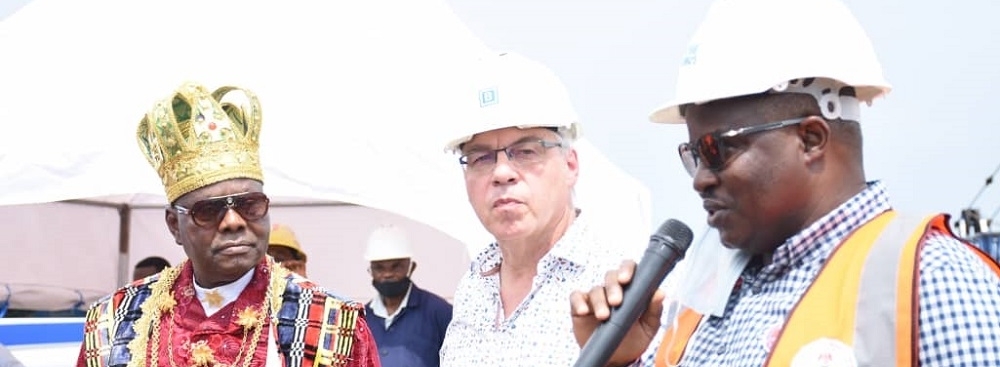
BODO-BONNY ROAD: FG ORDERS JULIUS BERGER TO RETURN TO SITE WITHIN 14 DAYS OR FACE SANCTIONS The Federal government has ordered the contractor handling the Bodo- Bonny road construction to return to site within 14 days or risk appropriate sanctions. Works Minister, His Excellency, Distinguished Sen. Engr. (Dr) David Umahi gave the marching order today at a meeting with the handlers of the road project, Julius Berger PLC , as well as representatives of Nigeria Liquefied Natural Gas NLNG and Royal Fathers from Bonny Kingdom and other members of host communities in Abuja. According to the Minister, the Bonny-Bodo road contract which was initially awarded at the cost of N120 billion in 2015, was later varied at N199 billion with a completion dateline of December 2023, which has since elapsed. The Minister deplored the unilateral stoppage of work by Julius’ Berger, describing the action as unacceptable. While rejecting in total, Julius Berger’s request for variation based on fluctuations in exchange rate and increasing cost of material, the Minister said government does not award contract based on exchange rate. He pointed out that no contractor will come to government for a downward review of the cost of any project if the exchange rate becomes one naira to one dollar, adding that government cannot anchor contract cost based on exchange rates variations. Senator Umahi was particularly unhappy that the timelines for the completion of the project were not adhered to, maintaining that if the project were completed in December 2023, as contained in the contract agreement , issues of high exchange rate and increasing cost of materials would not have arisen ‘ He however promised that he would make a presentation to Mr President and commander in Chief His Excellency Bola Ahmed Tinubu for a marginal augmentation to ensure that the project is completed on or before December 2024, particularly in the Spirit of the Renewed Hope Agenda and the love President Tinubu has for Bonny Kingdom and other host communities in the Niger Delta Region. Earlier in his presentation, the Managing Director, Julius Berger Plc Engr Dr. Lars Richter called for the variation of the contract which he said has become necessary in view of the declining value of the Naira and rising cost of construction materials in the country. The Managing Director drew the attention of the Minister to the time lag when the contract was awarded in 2015 when the exchange rate was N305 to a dollar, adding that the cost of building materials has since risen by over 1000%. Contributing, the Deputy Managing Director of NLNG, Olakunle Osobu pointed out that the contract which is being funded through the Tax Credit Scheme is intended to complement the Renewed Hope Agenda of the current administration, calling on all parties to the project to remain patriotic as well as make the necessary sacrifices for the actualisation of the project. On their part, Roya Fathers of Host Communities led by Chief Abel Attoni, Palace Secretary, Bonny Kingdom expressed profound gratitude to President Bola Ahmed Tinubu over the decision of the Renewed Hope administration to ensure that Bodo-Bonny road is completed. His Royal majesty applauded the commitment of the Works Minister to the road project especially coming at a time the Nation is experiencing economic difficulties. ...
Those Criticizing the Ongoing Lagos- Calabar Coastal Highway Project Being Done by The Renewed Hope Administration Of President Asiwaju Bola Ahmed Tinubu Either Have Little Knowledge of the Concept of EPC+F On Project Financing Or Are Deliberately Sacrificing The Cause Of Development At The Altar Of Politics The trending posts of criticisms by some notable politicians on the propriety and priority of the Lagos-Calabar coastal highway project being executed by the Renewed Hope administration of His Excellency President Asiwaju Bola Ahmed Tinubu GCFR are no doubt baseless thoughts of critics who are either bereft of the knowledge of the workings of the project initiative or they deliberately want to sacrifice the modest developmental efforts of Mr. President at the altar of their political ambitions. It is unthinkable that such highly placed people fail to understand the various elucidations provided by the Honourable Minister of Works, His Excellency, Sen Engr Nweze David Umahi CON on when the project was conceptualized, the various administrations that attempted but failed to carry out the project, the economic and technical considerations that gave rise to the commencement of the project under the Renewed Hope administration, the funding and procurement details and indeed the dimensions, importance, priority and propriety of the projects in the national developmental trajectory. For the avoidance of doubt, the Lagos- Calabar coastal highway project is being done under EPC +F. What does this type of funding entail? This is a project financing mechanism in which EPC+F contractors also arrange financing for the project. EPC+F is Engineering, Procurement and Construction plus Financing. Engineering here includes design and specification. This initiative provides a fixed price, fixed date, and transfers risks to the contractor. This type of funding requires only a counter- part funding from the Federal Government. Such funds are sourced by contractors where they have confidence in the economic policies of government, which essentially entails allowing the participation of the private sector in the road infrastructure development through PPP or EPC+F. In the recent Inauguration of the Committee on Compensation of owners of properties that will be affected by section 1 of the Lagos- Calabar Coastal Highway, the Honourable Minister emphasized the nature of the project funding and the workings of EPC + F when he said, "And graciously, Mr. President had approved that this section three will start from Calabar, which is the end point of the project, and start running towards Akwa Ibom. So, the 700 km is procured under phase one, in phases, and it's EPC +F. EPC+F is engineering, procurement, construction, and finance. And so, under this kind of arrangement, the contractor is expected to bring in a certain amount of money, and Federal Government is expected to pay certain counterpart funding." No patriotic Nigerian should discourage this kind of project where funding is substantially from the contractor. There is no doubt that Mr. President is aggressively tackling the backlogs of uncompleted road projects. In the 2023 Supplementary Budget, Mr. President approved funds for intervention on the over 260 dilapidated roads nationwide. The 2024 appropriation made provision for capital investment on our critical roads across the 6 Geo- political zones of Nigeria. The Honourable Minister has already made a great difference in the road infrastructure development roadmap of this administration through his new innovations on road construction and rehabilitation, his power of supervision, and his contract negotiation power which is second to none in the history of the Federal Ministry of Works. He has been touring around and supervising the various ongoing projects of the federal government, and the difference is already there. The people are testifying of the quality and speed of road projects being executed by the Renewed Hope administration. He has proven track records on road infrastructure development. He is not into rhetorics like many politicians who talk high but can do only less. The administration of President Tinubu is doing roads that will stand the test of time. The roads he is fixing will facilitate economic recovery. The patriotic Nigerians are already applauding the good efforts of Mr. Presidentt, but professional politicians are busy criticizing a landmark project that will launch Nigeria into the league of the best economies of the continent. On the importance of the Lagos-Calabar coastal highway project to the economy of the nation, it is clear that the coastal highway, when completed, will foster national economic growth. Notably, all roads in the country are important as reflected by the interventions of this administration on road rehabilitation across the nation, but the coastal highway offers much more economic benefits to the nation because of its connectivity to the North and South through the existing spurs. The road, when completed, has the potential to increase Nigeria’s GDP and trigger industrialisation, create trade, enhance the transportation of goods and services, and safety of road users.The road is going to be the biggest super highway in Africa in terms of the structure and solidity as we all as utility value, having ten lanes with a rail track designed for concrete technology, covering 700 kilometers. It is going to attract foreign direct investment to Nigeria, and it is going to trigger economic development. It is going to develop the potential of our coastal businesses, especially at the local economic corridors, and boost tourism and marine businesses. ...
Lagos- Calabar Coastal Highway: A Renowned Policy Analyst Describes Cost of Project as One of The Most Effective Project Figures in The World, Says Sen. Umahi's Negotiation Power is Second to None Blueprint Newspaper Written By Bode Olagoke A think tank body of policy analysts on the platform of the Independent Media and Policy Initiative (IMPI) Wednesday justified the N2.8trn to be expended on the construction of the Lagos-Calabar coastal highway. The group said the cost of construction of the highway "is appropriate." It also faulted former Vice President Atiku Abubakar's criticism of the project, saying there is enough proof to support the cost of the mega project. IMPI in a statement by its chairman, Niyi Akinsiju, in Abuja Wednesday said its study of the situation shows that all the claims by the Peoples Democratic Party (PDP) presidential candidate were off the mark and targeted at discrediting the project. The think tank group acknowledged the track record of the project handling firm in constructing coastal highways with reinforced concrete in many countries, citing the successful handling of the Bar Beach Shoreline protection. On Atiku's criticism of the cost of the project, the policy group insisted that a cost analysis of road projects similar to the Lagos-Calabar highway in some parts of the world show that the cost of the project was appropriate. The statement reads: "We note that there is no unified standard pricing template for the cost of building a kilometre of road anywhere in the world. The realities of road building have much to do with several variables: location, train, type of construction, number of terrain, lanes, lane width, surface durability, and the number of bridges, to name a few. "Yet, for engagement, we reviewed some cost estimates in some other countries to establish the context of fraud or otherwise that Waziri Abubakar is trying to throw up. "To build a 2-lane road of 12 metres wide of each lane with no bridges in states of North Eastern United States of America is $3.34m per km (when converted to Naira using the N1200/$ adopted by Umahi, it comes to N4.08bn per km) while the same 2-lane road in South Eastern USA with no bridges is $ 3.78m per km (N4.53bn per km) "According to the Texas Department of Transportation, the average cost of building a concrete road in rural areas is around $2.5m per mile, while in urban areas, it can costs upwards of $5m per mile. "In California, the estimated cost of building a concrete road ranges from $3 million to $6 million per mile, depending on the location and other factors. In Australia, average road project costs were around $5.1m (N6.12bn) per lane kilometre in 2017. "But in Bangladesh, according to the World Bank, the estimated cost of construction is $6.6m (N7.92bn) per kilometre for the Rangpur-Hatikumrul highway, $7m (N8.4bn) per kilometre for Dhaka-Sylhet highway, $11.9 million (N14.28 billion) per kilometre for Dhaka-Mawa highway. This underscores cost differentials in road construction because of peculiarities in terrains." ...
FG Assures Completion of Bodo-Bonny Road, Bridges on Schedule
The Federal Government has assured Nigerians that the construction of the Bodo-Bonny road would be completed on schedule as funding would no longer be a challenge.
This was disclosed by the Director Highway Road Design, Federal Ministry of Works and Housing, Engr. Omotayo Awosanya during an inspection tour of the project to ascertain the level of work done and update Nigerians on what the present administration had achieved so far on the project.
According to Engr.Awosanya the project had a counterpart funding mechanism when it was awarded in 2014, 50% from the Ministry and the remaining 50% from the Nigeria Liquified Natural Gas Limited.
He stated that funding would no longer be an issue in the execution of the project because the Federal Government is adopting the Tax Credit Scheme with the Nigeria Liquified Natural Gas Limited to completely fund the project.
Out of the 37.9km road, Engr.Awosanya disclosed that 31km has been completed. He said that with the speed of work put in by the contractor,Julius Berger Nigeria Plc recently, the project would be delivered in November 2021 as scheduled.
He further stated that the project was important to President Muhamadu Buhari as it would open up Bonny Island in particular and generally lead to economic empowerment of the country as a whole.
Speaking during the site visit, the Project Manager of Julius Berger Nigeria Plc, Thomas Haug said since commencement of work two years ago, his company had completed all the parapets, started work on eight mini bridges and constructed 200m long pipeline crossing bridge. He said two mini bridges had been constructed and 1.4million cubic meters of sand dredged to the point of the inspection.
Mr. Haug disclosed that they would be constructing the major bridge at Opobo next.
Also speaking, His Royal Highness, Chief Benson Egwenre, a community leader from Andoni said the community was happy especially with the prospects of economic benefits from the project. He said as per local content, the contractor has promised to employ youths of the community from January next year.
However, a total of 587 persons have been employed by the Contractor, out of which 438 (consisting of unskilled, semi-skilled and skilled labour) are from the immediate host communities while more people will be employed from the host communities by the main contractor, Julius Berger Nigeria and subcontractors as the work progresses.
Remarks By H.E, Babatunde Raji Fashola, SAN At The 26th Monthly Power Sector Operators Meeting At The Ohiya Transmission Substation, Umuahia, Abia State On Monday The 9th Of April 2018
I am pleased to chair this month’s Power Sector meeting and to welcome all of you here present.
This is the 26th meeting we are holding and its continuing nature is consistent with our road map of incremental, stable and, eventually, uninterrupted power.
We are on a journey to a destination of promise and eventual prosperity and I use this occasion to salute the efforts and contributions of all those who have brought us this far.
Even if those who were most vocal in condemnation when the situation appeared very dire are now uttering some muted acknowledgment that it has improved, we must continue to draw inspiration from well-meaning and right thinking Nigerians who were gracious enough to publicly acknowledge that:
They are saving some money from Diesel they used to spend for generators;
They are running their generators for fewer hours; and
They are getting comparably more power than before.
It is because of those gracious and well-meaning and right thinking Nigerians that we must dig deeper, work harder and be more determined to improve service delivery.
In order to improve service, we must accept our respective responsibilities and this is important for the purpose of identifying our respective roles and tasks.
At the risk of repetition and for the sake of clarity, let me state that since the privatisation process of 2013, Generation of Power and Distribution, which is supply to homes, offices and markets, factories and consumers generally is now a private sector business.
The exceptions are the NIPP Projects, which the Federal Government is trying to complete and dispose of, and Yola Distribution Company, which the investor surrendered.
Otherwise, the role of Government is to buy Bulk Power through NBET and vest in Distribution Companies to retail to consumers, and to transport the power from the generation companies to the distribution companies.
Government, through NBET and TCN, is executing these tasks by signing Power Purchase Agreements (PPAs) with Prospective Power Generators, where the terms are agreeable.
It is investing in the expansion of the Transmission Capacity through TCN, by building more Substations and expanding existing ones, to improve service capacity where the Consumer demand has increased, and reinforcing the capacity of existing transmission lines.
At the moment, there are over 90 (ninety) TCN projects for transmission expansion, which TCN will be commissioning nationwide in the next few weeks and months. Some are completed and some are nearing completion.
Today, we will commission two of such projects, namely:
a. The expansion of Umuahia sub-station with a new 40MVA transformer to increase transmission capacity from 80 MVA to 120MVA to serve Umuahia, Isikwutor, Isukwuato, Bende, Umunneochi, Ikwano, Obowo, Ohafia and parts of Arochukwu among other places ; and
b. The expansion of Aba Sub-station with a new 60MVA to increase service capacity from 127. 5 MVA to 187.5 MVA to serve Aba North and South, Ukwa East and West, Osisioma, Obioma-Ngwa, Isi ala Ngwa and environs.
And these are examples of our commitment to service delivery.
The same is also true of NDPHC, who have over 100 (one hundred) Distribution Projects in various stages of completion, under the NIPP.
Over the next few weeks and months, they will be going out to commission and energize those projects.
They will help the DisCos improve power supply and service delivery to those communities, and I appeal to the DisCos involved to take ownership of these facilities and put them to use.
On my part, I will do my best to keep track of developments and report them to the meeting.
NBET, on its part, must also improve on the timelines it takes to process payment to the DisCos and, in addition, adopt a business orientation of ensuring that it collects as much as it can from the DisCos, who help her to retail the Bulk Power.
The truth is that if NBET cannot pay her bills to the GenCos, the DisCos will have no business because the bulk of their power comes from NBET.
Therefore, the DisCos must, in their own very best interest see NBET as the goose that lays their golden egg, who must not die.
While NBET, TCN and NDPHC act for Government to implement its enabling role, the immediate tasks of the DisCos, in my view, are to:
A) Improve the quality and capacity of the distribution equipment to improve power supply and service to stimulate consumer willingness to pay;
B) Improve collection of revenues without extortion through estimated bills or hostility;
C) Remit what they collect in accordance with the agreement with NBET;
D) Take ownership of the Meter Asset Provider Regulations to improve supply of meters; and
E) Respond to consumer complaints and resolve them in a business-like manner.
On this last matter of consumer complaints, let me say that we are getting a number of them in the ministry in Abuja, from different parts of the country.
They should appropriately go to the DisCos and the private investors who own them.
Government has handed over these assets as a business and no longer collects revenue for power from consumers since the sale of PHCN in 2013.
Those who bought the DisCos and bill consumers must rise up to the responsibility of resolving consumer complaints.
Ladies and Gentlemen, these are some of the things that we all must do to improve service delivery, but they are not exhaustive.
Citizens and communities where we are building transmission lines must help to give us access to land.
I am happy to say that some Governors have responded admirably across party lines.
While it will be invidious of me to try to catalogue what different Governors have done, let me here acknowledge what Governor Okezie Ikpeazu of Abia State has done with his team to help us link a power provider with the traders and consuming business community in Ariaria Market, comprising of 30,000 shops.
Progress is being made on that project, under the joint supervision of Rural Electrification Agency and Abia State Government, and it should be completed this year.
The same is true in Sabon Gari Market in Kano, and Sura market in Lagos.
For these traders, stable power supply for their businesses will no longer be a mirage. It will happen.
It will happen because President Buhari is prepared to work across party lines to serve the ordinary people who work very hard daily and contribute to the task of building Nigeria.
Ladies and Gentlemen, my closing comment in these remarks is to the DisCos.
Get your employees out on the field.
Get them to inspect lines, breakers, transformers and other distribution equipment.
Get them to visit consumers and ask if they have problems, and fix them.
Get them to do preventative maintenance and notify your consumers in advance if it will result in disruptions of service, and state very clearly how long it will take.
I know that it may be difficult, but that is why we took our jobs; to do difficult things and improve people’s lives against the odds.
I know that you can do it, and I wait eagerly with other Nigerians as you roll out to prove us right for vesting these assets in you.
Babatunde Raji Fashola, SAN
Honourable Minister of Power, Works and Housing
Monday 9th April 2018
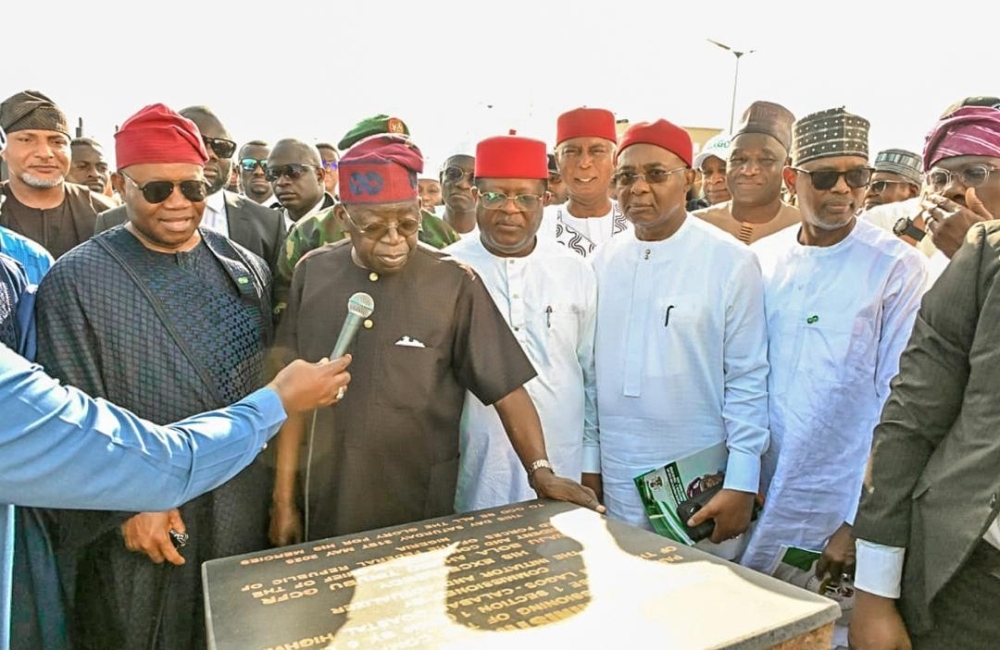
DRIVING NIGERIA’S FUTURE: CELEBRATING TWO YEARS OF TRANSFORMATIVE LEADERSHIP AND THE LAGOS-CALABAR COASTAL HIGHWAY MILESTONE
DRIVING NIGERIA’S FUTURE: CELEBRATING TWO YEARS OF TRANSFORMATIVE LEADERSHIP AND THE LAGOS-CALABAR COASTAL HIGHWAY MILESTONE
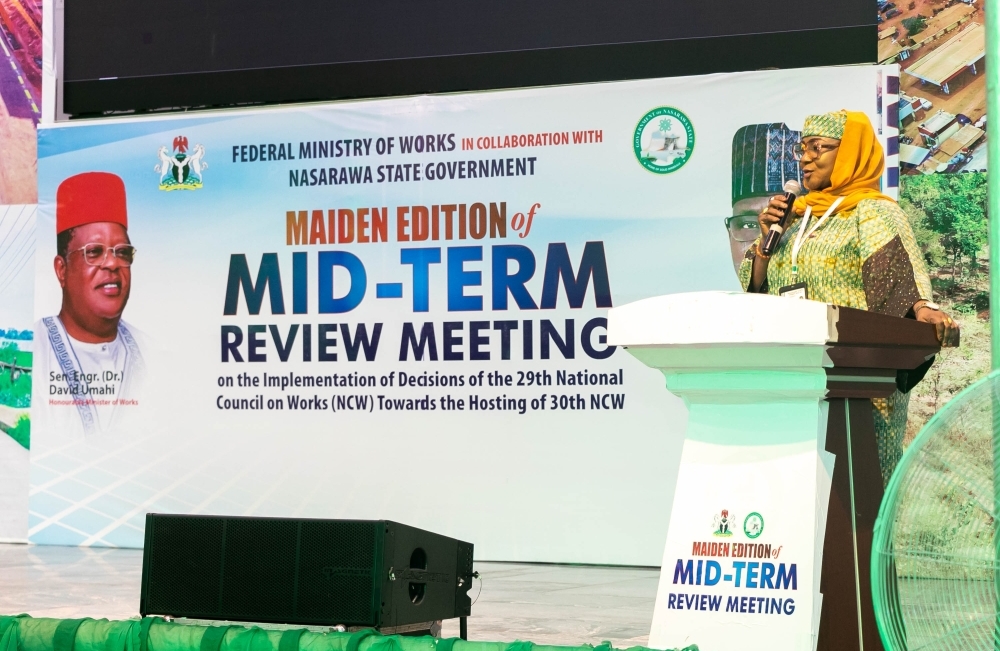
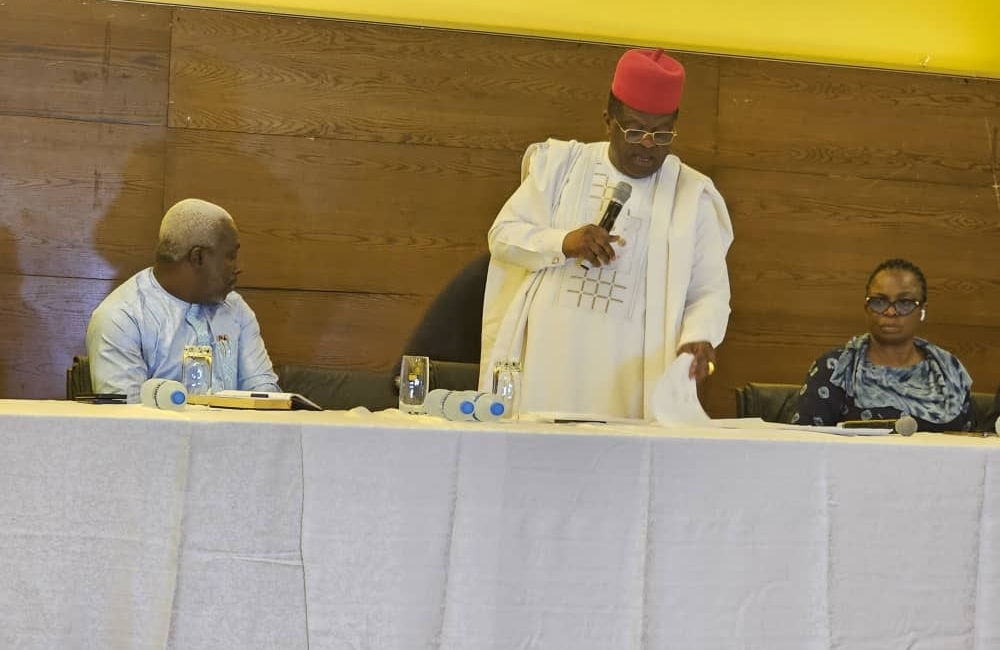
MID -TERM REVIEW MEETING ON THE IMPLIMENTATION OF THE DECISIONS REACHED AT THE 29TH NATIONAL COUNCIL ON WORKS (NCW) DAY 1
MID -TERM REVIEW MEETING ON THE IMPLIMENTATION OF THE DECISIONS REACHED AT THE 29TH NATIONAL COUNCIL ON WORKS (NCW) DAY 1